
Why Commercial Roof Leaks Often Start Around HVAC Units
Commercial roof leaks often start around HVAC units because these rooftop penetrations rely on curb flashing and seals that deteriorate over time, and because foot traffic from maintenance access damages the surrounding roof. Regular inspection of HVAC curbs and penetrations prevents leaks and business interruptions.
Quick Answer: The 90-Second Summary
- HVAC units are large penetrations in a commercial membrane, sealed by curb flashing that deteriorates over time.
- Seals, condensate drainage, foot traffic, and freeze-thaw weather all add to the risk around rooftop units.
- Prevention is practical: inspect curbs and flashing, inspect after servicing, and protect technician access routes.
- For commercial roof inspection in Northern Virginia, call Sam Construction Group USA: (571) 294-4977.
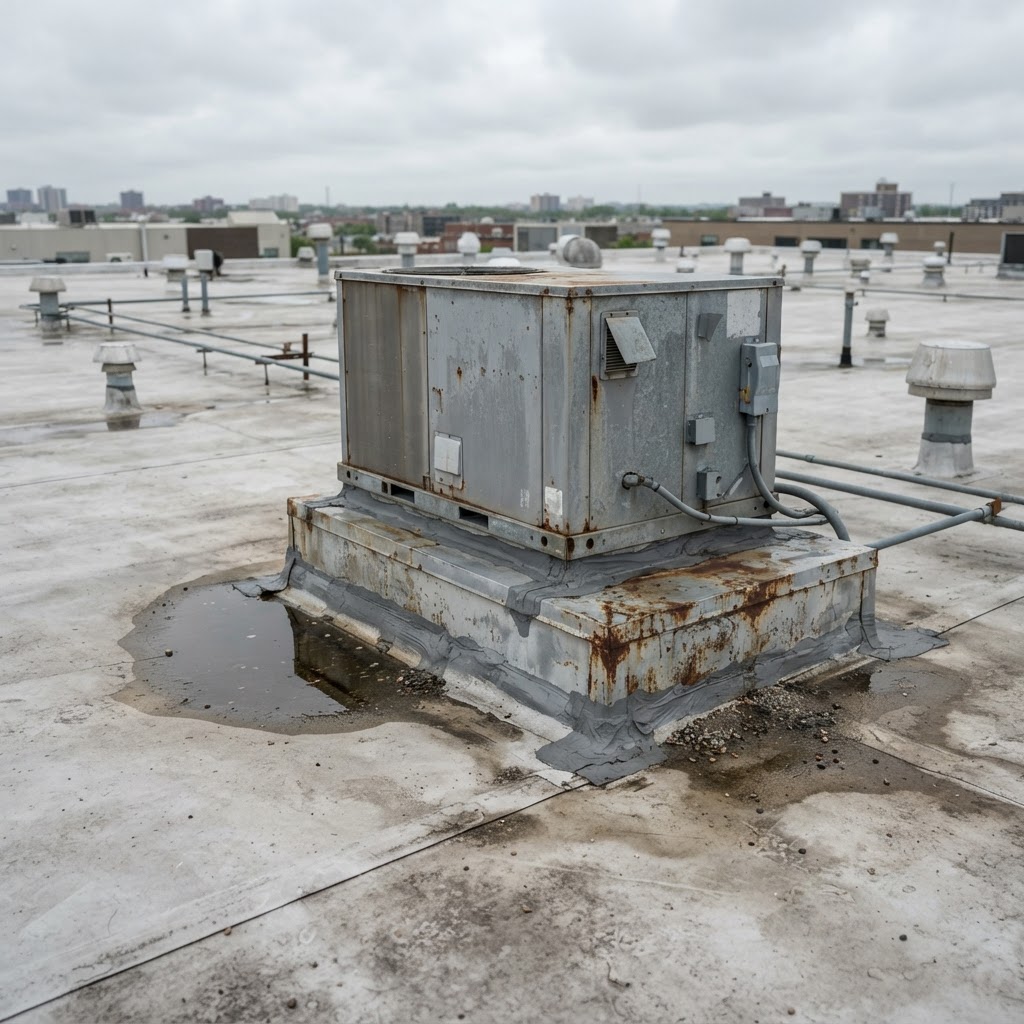
Why Rooftop HVAC Units Are a Common Leak Source
Rooftop HVAC units sit on the roof as large penetrations — interruptions in the roofing membrane that must be sealed watertight. Like any roof penetration, these are inherently vulnerable points, and several factors make HVAC units especially prone to leaks on Northern Virginia commercial buildings.
- Curb flashing deteriorates. HVAC units typically sit on a raised curb, and the curb flashing seals the joint between the unit’s curb and the roof membrane. Over time this flashing can crack, lift, separate, or fail — letting water in around the unit. Curb flashing failure is a leading cause of HVAC-related leaks.
- Seals and penetrations fail. Beyond the curb, HVAC units involve additional penetrations — electrical, refrigerant lines, condensate drains, and more — each with seals that can deteriorate and leak over time.
- Maintenance foot traffic. HVAC units require regular servicing, which means technicians walking on the roof around the units. This foot traffic can damage the roofing membrane around the HVAC unit, creating new leak points — an often-overlooked cause.
- Condensate and drainage issues. HVAC units produce condensate, and if drainage is not managed properly, water can pool and contribute to problems around the unit.
- Age and weather. Constant exposure of these components to sun, heat, and Northern Virginia’s freeze-thaw cycles accelerates the wear of seals and flashing around HVAC units.
Why These Leaks Matter So Much for Businesses
A leak around an HVAC unit can be especially damaging because these units are often located above critical interior spaces — offices, retail areas, equipment, or inventory. Water intrusion here can cause:
- Damage to inventory, equipment, and interiors
- Business interruption and downtime
- Disruption to tenants, customers, or operations
- Spreading water damage to ceilings, walls, and structure
For a Fairfax or Northern Virginia business, those consequences make HVAC-related leaks a priority to prevent.
How Property Managers Can Reduce HVAC-Related Roof Leaks
The good news is that HVAC-related roof leaks are largely preventable with proactive care:
- Regular inspection of HVAC curbs and flashing. Make the curb flashing and penetrations around every rooftop unit a focus of routine roof inspections.
- Inspect after HVAC service. Since maintenance foot traffic can damage the roof, inspect the area around units after HVAC servicing.
- Maintain seals and flashing. Address deteriorating curb flashing and seals promptly, before they fail.
- Manage condensate drainage. Ensure HVAC condensate drains properly and does not pool on the roof.
- Coordinate roofing and HVAC access. Where possible, use walk pads or protected paths for technician access to reduce membrane damage.
- Keep documentation. Track the condition of rooftop penetrations over time.
Why Professional Commercial Roof Inspection Matters
Because HVAC curbs and penetrations are technical, high-risk areas, professional inspection is key to catching problems early. A commercial roofing professional knows exactly what to check around rooftop units and can identify failing curb flashing or seals before they cause a leak and business interruption — and before water reaches the space below.
The Connection to Your Overall Commercial Roof Health
HVAC penetrations are one part of a commercial roof’s overall health, alongside drainage, seams, the membrane, and other penetrations. A comprehensive commercial roof maintenance program that includes attention to HVAC units protects the whole roof — and your business.
Protect Your Commercial Roof With Sam Construction Group USA
Sam Construction Group USA, a licensed and insured Fairfax, VA roofing and restoration contractor, provides commercial roof inspection, maintenance, and repair across Northern Virginia — including careful attention to the HVAC curbs and penetrations where leaks so often start. We help property managers prevent leaks and the business interruptions they cause, and respond promptly when issues arise.
Concerned about leaks around your rooftop HVAC units? Call Sam Construction Group USA at (571) 294-4977 to schedule a commercial roof inspection.
Schedule a Commercial InspectionFrequently Asked Questions
Why do commercial roof leaks often start around HVAC units?
Rooftop HVAC units are large penetrations in the membrane. The curb flashing that seals the joint between the unit’s curb and the roof can crack, lift, separate, or fail over time; the additional penetrations for electrical, refrigerant, and condensate lines have seals that deteriorate; and technicians servicing the units damage the surrounding membrane with foot traffic.
What is curb flashing on a commercial roof?
HVAC units typically sit on a raised curb, and curb flashing is the material that seals the joint between that curb and the roof membrane. Curb flashing failure — from cracking, lifting, or separating — is a leading cause of HVAC-related roof leaks on Northern Virginia commercial buildings.
How can property managers prevent leaks around rooftop HVAC units?
Make HVAC curbs and flashing a focus of routine inspections, inspect the area around units after HVAC servicing, maintain curb flashing and seals before they fail, manage condensate drainage so water does not pool, use walk pads or protected paths for technician access, and keep documentation of rooftop penetration conditions over time.
Why are HVAC-related leaks so damaging for a business?
HVAC units are often located above critical interior spaces — offices, retail areas, equipment, or inventory — so water intrusion can damage inventory and interiors, interrupt business, disrupt tenants and customers, and spread damage into ceilings, walls, and structure. Free commercial inspections: (571) 294-4977.
Stop Leaks Before They Reach Your Business
Sam Construction Group USA, a licensed and insured Fairfax, VA roofing and restoration contractor, provides commercial roof inspection, maintenance, and repair across Northern Virginia — with careful attention to HVAC curbs and penetrations. Call (571) 294-4977.
Schedule a Commercial Inspection