
Emergency Roof Repair Services: What They Do and When to Call One
Water coming through the ceiling changes your priorities fast. Here is what emergency roofers actually do, how quickly help arrives, and what your insurance expects from you.
Quick Answer — When to Call Emergency Roof Repair
- Call for active water intrusion, storm or fallen-limb damage, exposed decking, sagging sections, or fire damage.
- First hour: move valuables, catch draining water, relieve a bulging ceiling, photograph everything before you touch anything.
- First visit: emergency tarping, temporary sealing, interior water diversion, and insurer-ready documentation.
- Mitigation that stops further loss is typically covered by homeowner insurance — do not wait out an active leak.
- Avoid storm chasers: no door-knockers, no upfront payment, and always verify a local address and license.
What Counts as a Roofing Emergency?
Not every roof problem is an emergency, and knowing the difference saves both money and panic. A missing shingle over a dry attic can usually wait for a scheduled appointment. Water dripping into a living room cannot, because every hour of water intrusion multiplies the interior damage.
Structure changes the calculus too. A limb resting on the roof, decking you can see daylight through, or a roofline that has started to sag all count as emergencies even when the ceiling below is still dry. Northern Virginia sees enough summer thunderstorms and winter nor’easters that these calls cluster after weather — which is exactly when the worst crews come out as well.
When you are standing in the driveway deciding, sort by water and structure:
| Situation | Call Now or Schedule? | Why It Matters |
|---|---|---|
| Water dripping into living space | Call now | Active intrusion ruins insulation, drywall, and flooring by the hour |
| Missing shingles, no interior leak | Schedule within days | The deck stays dry in fair weather, so a planned visit is safe |
| Tree limb resting on the roof | Call now | The load can shift or open a puncture with the next gust |
| Roofline visibly sagging | Call now | Possible structural failure; keep people out of the rooms below |
| Damaged or lifted flashing | Schedule soon | A slow-leak risk that is cheap to fix before the next rain |
What Should You Do in the First Hour of a Leak?
The first hour is about limiting damage, not fixing the roof. Nobody should climb a wet, windy roof — emergency crews carry the harnesses, anchors, and experience for that. Your job is protecting the interior and building the paper trail your insurance adjuster will want later.
Ceilings deserve special respect. Water pools above drywall until the whole panel comes down, so a bulge the size of a dinner plate should be relieved deliberately from below with a screwdriver and a bucket underneath. It feels wrong in the moment — and it prevents a collapse.
Work through the same sequence every time, in this order:
- Move electronics, rugs, and furniture out from under the leak.
- Set buckets and towels wherever water is already traveling.
- Relieve a bulging ceiling carefully to drain the trapped water.
- Photograph and video the leak, the ceiling, and any visible roof damage.
- Call an emergency roofing crew, and your insurer if the damage looks major.
What Do Emergency Roofers Do on the First Visit?
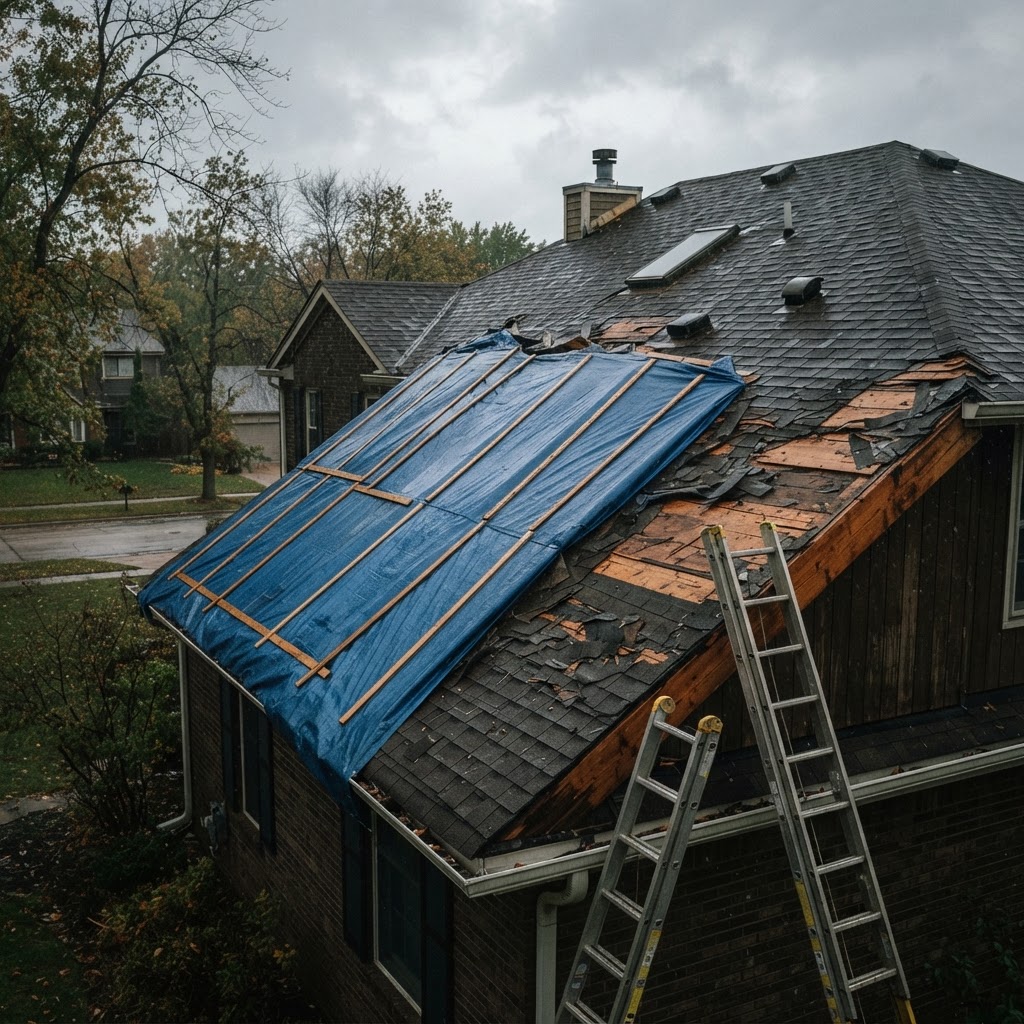
Emergency roof repair services do not mean a full repair happens in a downpour. They mean the loss gets stopped: an anchored tarp over the breach, sealant or patch panels where they will hold, and water routed away from finishes. Permanent repairs wait for dry weather and a proper diagnosis.
What Is Mitigation, Exactly?
Mitigation is the insurance term for work that stops damage from spreading. Insurers expect homeowners to mitigate — failing to act can reduce what they pay — while the mitigation itself is usually a covered cost. That is why good crews document everything with time-stamped photos before, during, and after the tarp goes on.
Expect the first visit to take one to three hours for most homes. The crew should leave you with a written summary of what was stabilized, what it cost, and what still needs permanent work. That summary becomes the backbone of your claim.
How Fast Can Emergency Help Arrive?
Response time depends on two things: distance and demand. A local crew on a normal Tuesday can often be on a ladder the same day. After a named storm, every rostered roofer in the region is working, so dispatch becomes triage — active intrusions and structural risks go first, and everyone else is scheduled in order.
This is where local accountability pays. A company based in your area knows the streets, the housing stock, and the inspectors, and it cannot disappear after the job because its reputation lives next door. National storm crews roll in fast and roll out faster.
What Should You Ask When You Call?
Ask three questions before anyone rolls: how quickly can a crew be on-site, what will the visit cost before insurance, and is the tarp-and-seal work guaranteed until the permanent repair. Straight answers to those three questions separate professionals from opportunists. Write the answers down, because you will want them later.
Will Insurance Cover Emergency Roof Repairs?
Homeowner policies generally treat mitigation favorably. Tarping, temporary sealing, and board-up stop the insurer’s loss from growing, so carriers routinely reimburse them when receipts and documentation are in order. Permanent work is a different question that turns on what caused the damage and how your policy values the roof.
What Does the Adjuster Need From You?
Before anything is repaired, photograph and video the damage, keep every receipt, and get the emergency crew’s report in writing. Your insurance adjuster will want cause, extent, and timeline, and the crew’s file supplies all three. File the claim promptly, because most policies expect notice within days rather than months.
“The claims that go smoothly look boring: photos before the tarp, receipts in a folder, one written report. The claims that stall are the ones where someone cleaned up first and reconstructed the story later.”
— Sam Construction Group USA, insurance claims team
Watch two policy terms when the paperwork arrives. Actual cash value policies subtract depreciation from payouts, while replacement cost value policies do not. And remember your deductible — on a small repair, the payout after the deductible may be modest, which is worth knowing before you file.
How Do You Avoid Storm-Chaser Scams?
Storm chasers follow the radar. They arrive within days of a hail band, quote fast, demand faster, and are untraceable by the time the tarp fails. The damage they leave behind — improper tarping, skipped permits, ghost warranties — often costs more than the original storm did.
Treat any of the following as a reason to keep your wallet closed:
Storm-chaser red flags
- Pressure to sign on the spot, especially “before the price goes up”
- Requests for full payment upfront or cash-only deals
- No local address, no license number, no proof of insurance
- Offers to “cover your deductible,” which is insurance fraud
- Reluctance to put a scope of work in writing
“After a big hail year, we re-do more roofs than the weather damaged. The pattern never changes: out-of-state plates, a handshake, and a warranty nobody honors in the spring.”
— Storm Restoration Project Manager, Sam Construction Group USA
Legitimate local contractors do the opposite. They welcome written scopes, carry verifiable licensing, accept staged payments, and stand behind emergency tarping until the permanent repair is done. If a crew fails even one of those tests, the cheapest bid in town is still too expensive.
When Is a Temporary Repair Enough — and When Do You Need More?
A tarp is a bridge, not a destination. It keeps the next rain out while materials are sourced, the adjuster visits, and the forecast settles. If the damage stayed at the shingle layer, the permanent repair is often a straightforward scheduled job once weather clears.
Escalate quickly when the warning signs stack up. Water stains that reappear after every rain, decking that feels soft underfoot in the attic, or daylight at the roofline all point past the shingles. At that stage, ask for a full written inspection and an honest repair-versus-replace conversation — waiting through another season usually makes the larger bill inevitable.
Emergency Roof Repair — Frequently Asked Questions
Should I call a roofer or my insurance company first?
Call the roofer first if water is entering the home — stopping the damage is your duty under the policy, and crews document what the adjuster needs. Then notify your insurer, usually within days of the loss.
Can a roof be tarped while it is still raining?
Yes. Emergency crews tarp in active rain using anchored, weighted systems, while permanent repairs wait for dry conditions. You should have a working interior defense within a single visit.
How long can a tarp stay on a roof?
Weeks, not months. Tarps degrade in sun and wind, and a tarp is a stopgap, not a roof. Schedule the permanent repair as soon as the forecast and your insurer allow.
Does emergency service cost more than a scheduled repair?
Usually there is an after-hours or rapid-response premium, often a few hundred dollars for stabilization work like tarping. Most homeowner policies reimburse reasonable mitigation costs, so keep every receipt.
Will my insurer penalize me for filing an emergency claim?
Filing a legitimate damage claim is what insurance exists for. Carriers look at claims history over time, but a documented storm loss with clean mitigation paperwork is a normal event, not a red flag.
Need an Emergency Roofing Crew in Northern Virginia?
Sam Construction Group USA provides emergency response for homeowners across the Northern Virginia and DMV area — tarping, sealing, documentation, and the permanent repair that follows. If water is coming in right now, call us. We answer around the clock.
☎ (571) 373-6388This article is general information for Northern Virginia property owners and is not a quote or a statement of any specific product’s terms. Costs, lifespans, and savings vary by home, climate, and product line — always confirm specifications for your own project. Free inspections: (571) 373-6388.