
How to Clean and Maintain a Shingle Roof Without Damaging It
Black streaks and green moss look alarming, but the bigger threat is the wrong cleaning method. Here’s how to soft wash safely, keep granules where they belong, and run a maintenance rhythm that adds years to your shingles.
Quick Answer — Safe Roof Cleaning
- Clean with a soft wash: low-pressure water, sodium hypochlorite, and a surfactant — never a pressure washer.
- Most roofs need a full cleaning only every few years; inspect and clear gutters twice a year.
- Treat algae and moss from the ground or a stable ladder; install zinc or copper strips to slow regrowth.
- Trim branches, check flashing, and watch gutters for granules every spring and fall.
- Anything above a walkable single story belongs to a professional crew — falls cost more than cleanings.
How Often Should a Shingle Roof Be Cleaned?
The black streaks that run downhill from ridge to gutter on shaded roofs are not dirt, and they are not soot from a highway. They are colonies of Gloeocapsa magma, a cyanobacteria that feeds on the crushed limestone filler inside asphalt shingles and spreads wherever shade and humidity give it a foothold. Northern Virginia’s humid summers and mature tree canopy make our north-facing slopes ideal habitat, which is why the streaks always seem to start on the side of the house you see least. Once established, the colony spreads downhill with every rain.
Knowing the cause makes the timing easier. Cleaning is warranted when growth is more than cosmetic — when streaking covers a large share of a slope, when moss holds visible moisture, or when debris is damming the valleys. Light early streaking can wait for a scheduled cleaning; washing more often than necessary trades shingle life for looks.
Why Is Pressure Washing Bad for Shingles?
Granules are the armor of an asphalt shingle: the mineral coating reflects sunlight, protects the asphalt from UV degradation, provides fire resistance, and gives the surface its color and weight. At residential-washer pressures, water strips granules in a visible swath, exposes the black asphalt mat beneath, and accelerates the exact aging the coating prevents — a roof aged by a decade in an afternoon.
The damage is not only cosmetic. High-pressure water drives up beneath shingle laps and around flashing, wetting underlayment and decking that are designed to stay dry, and it can break the self-sealing bond that wind resistance depends on. Most warranty language also assumes maintenance consistent with ARMA guidance — low-pressure cleaning only — which leaves pressure-washed roofs on thin ice in any coverage dispute.
We can spot a pressure-washed roof from the street — bare black patches, a pile of granules in the gutter, shingle edges curled back. The homeowner saved a few hundred dollars on cleaning and gave up years of shingle life to do it.
— Sam Construction Group USA, Fairfax roofing & restoration team
What Is the Safe Way to Remove Algae and Moss?
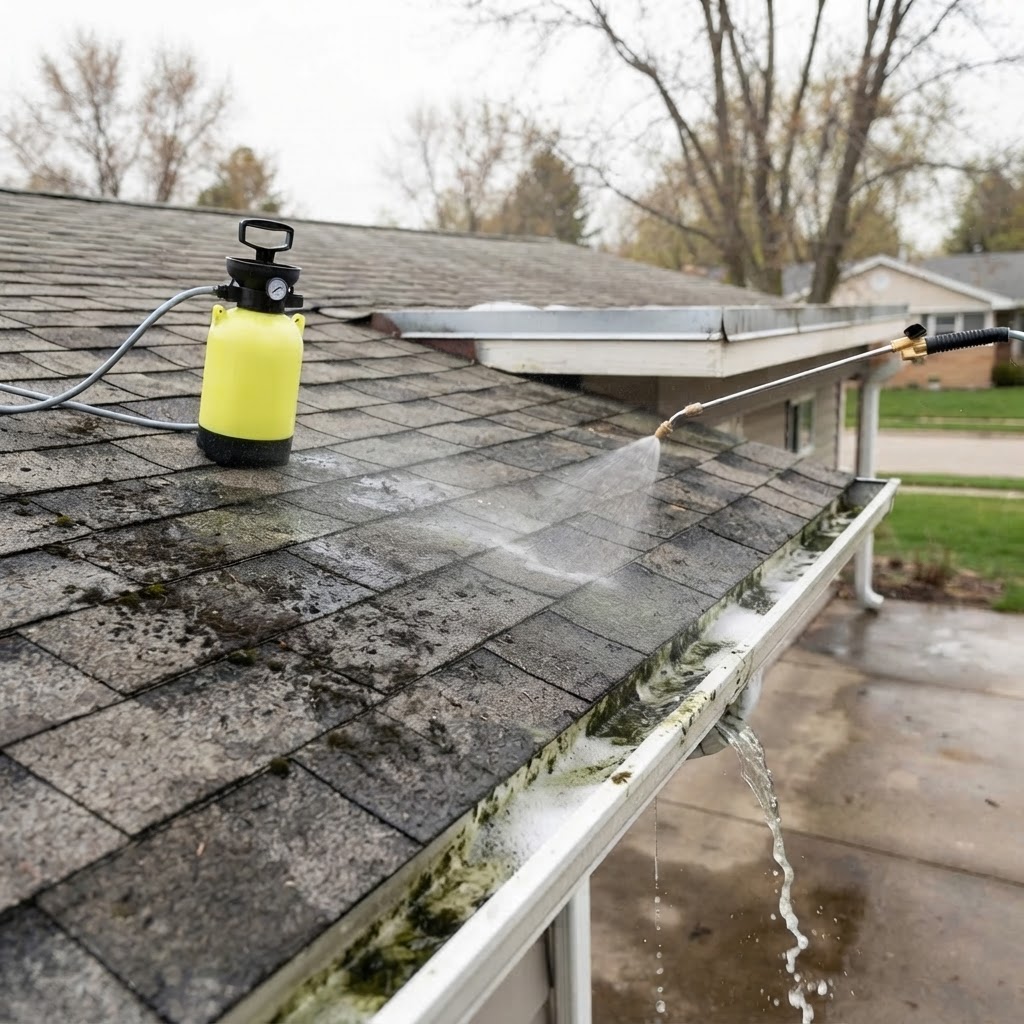
Soft washing flips the physics of roof cleaning. Instead of mechanical force, it uses a cleaning solution — typically water mixed with sodium hypochlorite and a surfactant that helps it cling to sloped surfaces — applied at pressures comparable to a garden hose. The solution kills the algae and moss at the root rather than shearing off the visible layer, and the dead growth rinses away or weathers off over the following weeks. It is the method consistent with Asphalt Roofing Manufacturers Association guidance for asphalt shingles.
A basic soft wash, done from a ladder or the ridge with proper fall protection:
- Rinse down plants, shrubs, and the lawn below the work area so any runoff is diluted from the start
- Mix the solution to the manufacturer’s labeled ratio and load it into a low-pressure applicator
- Apply from the bottom of the slope upward at near-garden-hose pressure, wetting the shingles evenly
- Allow 15 to 20 minutes of dwell time, re-misting any area that dries before the kill is complete
- Rinse gently from the top down, letting the solution carry off without blasting the surface
- Rinse the surrounding vegetation again and flush gutters so no concentrated residue remains
Moss deserves patience. Because it anchors into shingle joints, live moss should be treated and allowed to die before it is coaxed off with a plastic brush — metal tools and scraping pull granules and break shingle edges.
How Do Zinc and Copper Strips Prevent Regrowth?
Zinc and copper strips are the standard prevention upgrade after a cleaning. Installed under the ridge course and every few courses down, the metal releases ions with each rain that wash down the slope and inhibit regrowth. When the time comes to re-roof, algae-resistant shingles with copper-infused granules build the same protection into the product itself — worth requesting in a market as humid as ours.
What Does a Yearly Maintenance Plan Look Like?
Shingle roofs are built to be low-maintenance, not no-maintenance, and the work that extends their life is modest and seasonal. Gutters are the anchor habit: when they clog, water overflows the back edge, wets the fascia and eaves, and creates the damp shaded edge where rot and ice damage start. Trimming branches keeps shade — and with it, algae habitat — under control while eliminating the limbs that scuff granules in every windstorm.
| Season | What to Do | Why It Matters |
|---|---|---|
| Spring | Clear gutters, inspect for winter damage, check flashing and sealant | Catches freeze-thaw damage before spring rains find it |
| Summer | Trim branches back from the roof; schedule cleaning if streaking has spread | Reduces shade, debris, and scuffing during storm season |
| Fall | Clear gutters again; remove leaf buildup in valleys; final visual inspection | Prevents clogs and ice dams heading into winter |
| Winter | Watch for ice dams and icicle buildup at the eaves from the ground | Signals attic heat loss worth fixing before spring |
| After storms | Walk the property, photograph anything new, check the attic with a flashlight | Early documentation protects both repairs and insurance claims |
Granules in the gutters are the quiet diagnostic. A handful is normal aging; a heavy accumulation after every rain means the surface is shedding its coating and a roofer should take a look. The attic half matters just as much — daylight at the deck or damp insulation after a storm announces a leak while it is still a cheap repair.
When Should Cleaning Become a Professional Job?
The honest answer to most do-it-yourself roof cleaning questions is that the ground is the best place to start. A single-story home with a walkable pitch can sometimes be soft-washed by a careful homeowner with a pump sprayer. Everything above that threshold involves ladder time on a wet, sloped surface — and wet is exactly when roofs are most dangerous.
If your feet leave the ground, the risk math changes completely. The falls I get called to investigate almost never happen to professionals — they happen to homeowners on extension ladders, on wet shingles, holding a sprayer.
— Production Foreman, Sam Construction Group USA
Professional crews bring more than fall protection: insurance that covers the roof they stand on, knowledge of labeled mixing ratios that protect landscaping, and the judgment to tell growth that needs treatment from shingles that need replacing. Ask whether they soft wash, how they protect plants, and whether they photograph the roof before and after — companies worth hiring answer all three.
What Warning Signs Mean It’s Time for Repairs, Not Cleaning?
A cleaning company and a roofing company see the same roof differently. Algae streaks and surface moss are cleaning problems — biological growth sitting on the shingles. Structural wear is different: shingles that cup, crack, or go bald where granules have washed away are past the point where chemistry helps, and so are loose step flashing or shrunk sealant, because those details channel water straight into the deck.
- Curling, cupping, or cracked shingle tabs visible from the ground after a visual walk-around
- Bald patches of exposed black mat where granules have completely washed away
- Granule accumulation in gutters and at downspout outlets after every significant rain
- Lifted, bent, or rusted flashing at chimneys, skylights, wall transitions, and valleys
- Interior ceiling stains or attic sheathing stains that appear or worsen with rain
When several of these show up together, budgeting matters more than scrubbing. A professional evaluation tells you whether you are looking at targeted flashing repairs or a replacement on the horizon — and the honest answer is sometimes “not yet — clean it and check again next year.” That is the answer we give whenever the roof supports it.
How Much Does Professional Roof Cleaning Cost?
Nationally, Angi puts the average professional roof cleaning near $450, and our regional quotes tend to sit in that band for single-family homes. Pricing follows four variables: roof square footage, the pitch and height that control access, the density of growth, and the plant protection the property requires. A light algae treatment on a single-story ranch is the low end; a steep two-story colonial with established moss is the high end and may need a second kill cycle.
Be cautious with outliers on both ends. A quote far below the local band usually means pressure washing or a skimpy dilution — the cheapest cleanings are the ones that age your roof. An unusually high quote should come with an explanation, and bundled gutter cleaning or minor flashing resealing can make one fair. Ask for the method, the mixture, and the scope in writing, then compare what is included rather than the headline number.
Shingle Roof Cleaning — Frequently Asked Questions
Can I clean my roof without ever getting on it?
Often yes. Ground-level soft-wash systems with telescoping poles reach many single-story roofs, and rain eventually rinses loosened growth away on its own. Treat what you can reach safely from the ground or a stable ladder, and leave steep or tall sections to a professional crew.
Is bleach-based cleaning solution safe for my landscaping?
Diluted sodium hypochlorite is the standard soft-wash active ingredient, but it must be handled with care around plants. Pre-wet shrubs and lawn so any runoff dilutes further, rinse them again after the roof is rinsed, and collect downspout discharge where possible. Professional crews build plant protection into their standard process.
Will cleaning my roof void the shingle warranty?
No, not if it is done correctly. Manufacturers expect routine cleaning, and soft washing at low pressure is the accepted method aligned with Asphalt Roofing Manufacturers Association guidance. What puts warranty coverage at risk is pressure washing, aggressive scraping, or harsh solvent treatments.
Why do black streaks come back after cleaning?
Gloeocapsa magma spores travel through the air and recolonize shaded, humid slopes first. Cleaning kills the growth that is present, but regrowth within three to seven years is normal in humid climates. Zinc or copper strips and algae-resistant shingles slow the next colonization significantly.
Does moss always mean the roof is failing?
No. Surface moss is common on shaded roofs and can be treated and kept in check. The real concern is long-established moss that has lifted shingle edges or grown beneath laps, because it holds moisture against the deck — that situation deserves a hands-on evaluation by a roofer.
Keep Your Shingles Clean, Intact, and Long-Lived
Sam Construction Group USA cleans, maintains, and replaces shingle roofs across Northern Virginia — with soft-wash methods that protect granules and honest advice about which your roof actually needs. Book a free roof evaluation and get a straight answer in writing.
☎ (571) 373-6388This article is general information for Northern Virginia property owners and is not a quote or a statement of any specific product’s terms. Costs, lifespans, and savings vary by home, climate, and product line — always confirm specifications for your own project. Free inspections: (571) 373-6388.