
Storm Damage Roof Repair in Fairfax, VA: How to Spot It & Win Your Insurance Claim
Quick Answer
Most storm damage in Fairfax, Virginia is invisible from the ground — lifted shingles, granule loss, and bruised mat rarely leak on day one, but they leak months later after your claim window has closed. The clock starts the moment the storm passes, so get an independent inspection before you call your insurer. Sam Construction Group USA inspects, documents, and helps you file across Fairfax and Northern Virginia — call (571) 373-6388.
If you live in Fairfax, Vienna, Oakton, Burke, Annandale, or anywhere across Northern Virginia, you already know the drill: a summer thunderstorm turns the sky green, winds gust past 60 mph, the power flickers, and by morning the neighborhood is littered with branches. You walk the yard, glance up at the roof, and it looks the same as always. So you move on.
That instinct — “it looks fine, so it’s fine” — is what turns a covered insurance claim into a five-figure out-of-pocket repair eighteen months from now. This guide walks through exactly how storm damage works on a roof, how to spot it, how the insurance process actually plays out in Virginia, and how to make sure you’re not one of the homeowners who finds out too late.
Quick Answer: What to Know Right Now
- Most storm damage is invisible from the ground. Lifted shingles, granule loss, and bruised mat rarely leak on day one — they leak months later, after your claim window has closed.
- The clock starts the moment the storm passes. Your policy requires prompt written notice — waiting is the #1 reason claims get denied as “wear and tear.”
- Get an independent inspection before you call your insurer. Know what you’re claiming before the adjuster tells you what they’ll pay.
- Be wary of crews who show up uninvited after a storm. Storm-chasers descend on Fairfax after every major system — the good ones don’t need to knock on your door.
- A local, licensed contractor who handles the claim changes the outcome — proper documentation, accurate scope, and someone still here in two years if there’s a warranty issue.
How Do I Know If My Roof Has Storm Damage After a Fairfax Storm?
Direct answer
You usually can’t confirm it from the ground — but you can spot the warning signs: shingle granules collecting in gutters and downspouts, small dark bruises or bare patches on shingles, lifted or creased shingle edges, dented gutters or flashing, and any debris impact. Any one of these after a major storm warrants a professional inspection.
Roof storm damage comes in three main forms in Northern Virginia, and each hides differently:
Wind damage
Straight-line winds and gusts lift shingles, break the adhesive seal strip that holds them down, and crease them at the fold. A creased shingle looks intact but is structurally compromised — it will flap loose in the next storm and expose the underlayment. Winds also strip shingles entirely, and even a few missing shingles create an entry point for water.
Hail damage
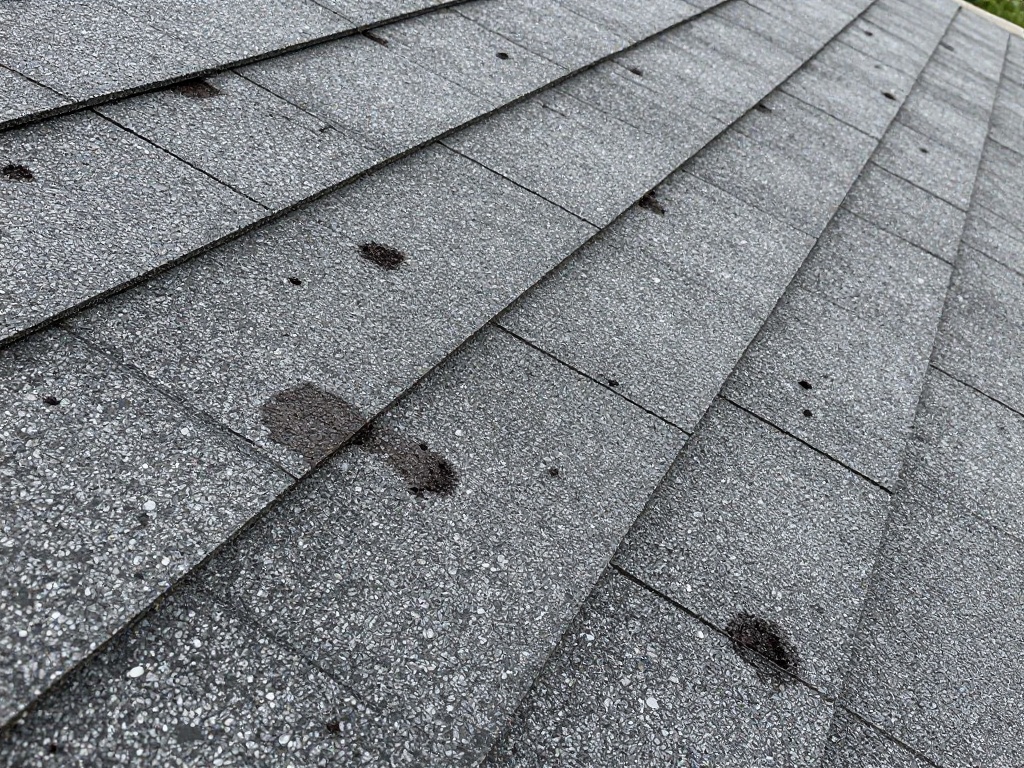
Hail doesn’t usually punch holes. It bruises the shingle — fracturing the fiberglass mat underneath and knocking off the ceramic granules that protect the asphalt from UV. That bruise is a slow leak waiting to happen. On a bright day from the driveway, a hail-damaged roof and a healthy roof look identical.
Debris and structural impact
Fallen limbs, airborne branches, and wind-driven debris can puncture decking, crack tiles, or damage flashing around chimneys and vents — the exact spots where leaks start.
Ground-level signs you can check safely:
- Granules (they look like coarse black sand) in gutters, downspout splash blocks, or at the base of downspouts
- Dents or dings on gutters, downspouts, metal flashing, the AC condenser, or your mailbox — hail hits everything, not just the roof
- Shingle pieces or whole shingles in the yard or on the driveway
- Visible lifting, curling, or dark patches when you look up at the roof planes
- Interior signs later: water stains on ceilings, a musty attic smell, or daylight visible through the roof deck from inside the attic
Never climb up to inspect yourself. A wet or storm-damaged roof is a fall hazard, and untrained foot traffic can cause more damage. Ground-level clues tell you whether to call — a professional confirms what’s actually happening up top.
Why Is Hidden Roof Damage More Dangerous Than a Visible Leak?
Direct answer
Because a visible leak gets fixed. Hidden damage sits untouched, silently rotting the roof deck and growing mold — and by the time it finally leaks, your insurer can argue the damage is old “wear and tear” rather than storm-related, and deny the claim.
Homeowners treat a dry ceiling as good news. But the most expensive roofing outcomes almost always start with damage that didn’t leak right away.
Here’s the timeline that plays out across Fairfax County every year. A summer storm bruises a roof in July. Nothing leaks, so the homeowner does nothing. Over the following months, water wicks through the fractured shingle mat, saturates the felt underlayment, and soaks into the plywood decking. That trapped moisture breeds mold and rots the wood. The following spring, a stain finally appears on a bedroom ceiling. Now the homeowner calls their insurer — but the storm is a distant memory, there’s no timely documentation, and the adjuster classifies it as gradual deterioration. Gradual deterioration is not covered.
The “delayed damage” trap
Standard Virginia homeowners policies cover sudden, accidental events like a storm — not gradual wear. The longer you wait after a storm to document and report damage, the easier it is for an insurer to argue the damage was pre-existing. Time literally converts a covered claim into an uncovered one.
What started as a repair covered by insurance minus a deductible becomes a full deck replacement, mold remediation, drywall repair, and a new roof — paid entirely out of your own pocket. The damage didn’t get more expensive because the storm was worse. It got more expensive because nobody looked.
How Often Does Northern Virginia Actually Get Roof-Damaging Storms?
Direct answer
Far more often than most homeowners realize. The Fairfax area has been under severe-weather warnings 43 times in the past 12 months, and Doppler radar has detected hail near Fairfax on 54 occasions in that window. NoVA sits in an active corridor for damaging summer storms.
Northern Virginia isn’t Tornado Alley, but it takes a real beating. The Fairfax area saw severe-weather warnings 43 times in a recent 12-month span, with radar-indicated hail on 54 occasions, according to Interactive Hail Maps.
In May 2025, severe thunderstorms swept the D.C. metro with near-hurricane-force winds — a 69 mph gust was recorded at Reagan National Airport — leaving roughly 200,000 customers without power, with Fairfax and Alexandria among the hardest-hit areas, per Fox Weather and the National Weather Service. Older residents remember the 2012 derecho that brought 80+ mph winds and knocked out power to more than half a million Dominion customers.
| Season in NoVA | Primary roof threat | What it does to a roof |
|---|---|---|
| Late spring / summer | Severe thunderstorms, hail, derechos | Shingle bruising, granule loss, wind lift, debris impact |
| Late summer / fall | Tropical storm & hurricane remnants | Sustained wind uplift, wind-driven rain intrusion |
| Winter | Ice, freeze-thaw, ice dams | Cracked shingles, ice-dam backup, flashing failure |
| Year-round | High-wind events & falling limbs | Missing shingles, punctures, damaged flashing at penetrations |
Because wind and hail are the #1 cause of homeowners insurance claims nationwide — accounting for roughly 40% of all claims in a recent year, per the Insurance Information Institute — the question isn’t whether your roof will face a damaging storm. It’s whether you’ll catch the damage in time.
“The homeowners who come out ahead aren’t the ones with the newest roofs — they’re the ones who get their roof looked at after every major storm. A ten-minute inspection is the difference between a covered claim and a conversation you don’t want to have with your insurer a year from now.”
— Sam Construction Group USA, Fairfax roofing & restoration team
Did a storm just pass over your neighborhood?
Don’t wait for a leak to tell you there’s a problem. Sam Construction Group USA offers free, no-obligation roof inspections across Fairfax and Northern Virginia.
What Should I Do in the First 72 Hours After a Storm Hits My Roof?
Direct answer
Document everything, prevent further damage, and get a professional inspection — in that order. The first three days set up (or sink) any insurance claim you may need to file.
- 1Stay safe and do a ground check. Walk the perimeter, photograph any debris, downed limbs, or visible roof damage. Note the storm date and time — you’ll need it for the claim.
- 2Document from the ground with date-stamped photos. Capture gutters, downspouts, the yard, and any interior water stains. More documentation is always better than less.
- 3Prevent further damage. If water is actively entering, place buckets and move valuables. Your policy expects you to take reasonable steps to limit additional damage — but don’t get on the roof yourself.
- 4Get a professional roof inspection. A qualified local contractor documents the true scope, including the hidden damage you can’t see, and gives you an honest read on whether it’s a repair or a claim.
- 5Review your policy. Check your coverage, your standard deductible, and whether you have a separate wind/hail deductible (more on that below).
- 6File promptly if damage is confirmed. Report the claim to your insurer with your date-stamped evidence and the contractor’s documentation in hand.
- 7Keep every receipt and record. Temporary repairs, tarping, and related expenses are often reimbursable — save proof of all of it.
How Does a Roof Storm-Damage Insurance Claim Work in Virginia?
Direct answer
You report the loss to your insurer, an adjuster inspects the damage, and the insurer pays out based on your policy — minus your deductible. Two details decide how much you actually receive: whether your policy pays Replacement Cost or Actual Cash Value, and whether you have a separate wind/hail deductible.
The process sounds simple, but the money lives in the fine print. Two policy terms matter most:
| Policy term | What it means | Why it matters to you |
|---|---|---|
| Replacement Cost Value (RCV) | Pays what it costs to replace the damaged roof today, with no deduction for age | Best case — you can restore the roof fully, often in two payments |
| Actual Cash Value (ACV) | Pays replacement cost minus depreciation for the roof’s age and wear | You absorb the depreciation gap out of pocket — on an older roof, that can be thousands |
| Wind/Hail Deductible | A separate, often higher deductible that applies only to wind & hail claims | Increasingly common; frequently a percentage of your dwelling coverage, not a flat amount |
The average wind and hail claim runs around $13,500, according to Insurance Information Institute data — enough that the ACV-vs-RCV distinction alone can swing your out-of-pocket cost by thousands of dollars.
The deadline most homeowners get wrong
Here’s a critical Virginia nuance. Virginia’s statute of limitations lets you file a property-damage lawsuit for up to five years — but that is not your claim deadline. Standard Virginia homeowners policies require you to give prompt written notice of a loss “as soon as reasonably possible.” Sitting on damage for months, even though you technically have five years to sue, is exactly what gives an insurer grounds to deny. Treat the storm date — not the five-year mark — as your real clock.
Why documentation wins claims
Adjusters work for the insurer. When you have an independent, professionally documented inspection before the adjuster arrives — with photos, measurements, and a detailed scope — you’re negotiating from evidence instead of hoping their assessment is complete. This is where a contractor who handles claims day-in and day-out earns their keep.
Should I Trust the Contractors Who Show Up at My Door After a Storm?
Direct answer
Be very cautious. Reputable local roofers don’t need to canvass neighborhoods door-to-door after a storm. High-pressure, out-of-town storm-chasers are a well-known industry problem — and hiring one can leave you with shoddy work and no one to call when it fails.
After every major Northern Virginia storm, out-of-state crews roll in, knock on doors, and pressure homeowners to sign on the spot — sometimes handing over their insurance claim entirely. Some are legitimate. Many are not. The pattern to watch for:
- They found you — you didn’t find them. They are going door-to-door, not earning referrals.
- High pressure to sign today, often an authorization or assignment of benefits that hands them control of your claim.
- Out-of-area address or a brand-new local phone number. When the roof leaks in two years, they’ve moved to the next storm in another state.
- Offers to waive your deductible — which is insurance fraud, and it puts you at risk, not just them.
- No verifiable Virginia contractor license, local reviews, or physical address.
A roof is a decades-long investment, and a warranty is only as good as the company standing behind it. The safest path is a licensed, insured, and bonded local contractor with a real Fairfax-area presence, verifiable reviews, and a track record you can check — someone who’ll still be here when you need them. Ask for the license number, confirm insurance, and read the reviews before anyone touches your roof.
What Happens If You Wait Too Long to Act?
Direct answer
Waiting is the single most expensive decision you can make. Delay converts covered damage into denied claims, small leaks into structural rot, and simple repairs into full roof-and-deck replacements you pay for yourself.
Let’s make the consequence concrete. Two identical homes in Fairfax take the same July hailstorm.
| Homeowner A — acts in 72 hours | Homeowner B — waits until it leaks | |
|---|---|---|
| Inspection | Free, documented within days | 18 months later, after a ceiling stain |
| Insurance outcome | Covered storm claim, pays deductible only | Denied as gradual “wear and tear” |
| Scope of work | Roof repair / replacement | Roof + rotted deck + mold + drywall |
| Who pays | Insurer (minus deductible) | Homeowner, in full |
Same storm. Same roof. The only variable is how quickly someone looked. That’s the whole ballgame — and it’s why a free inspection you actually use is one of the highest-return ten minutes in home ownership.
Is Commercial Storm Damage Different From Residential?
Direct answer
Yes. Commercial buildings usually have low-slope or flat roofs (TPO, EPDM, modified bitumen), where storm damage shows up as membrane punctures, seam separation, and ponding water rather than lifted shingles — and business-interruption stakes are much higher.
If you own or manage a commercial property in Northern Virginia, storm response is even more time-sensitive. Flat and low-slope roofs hold water, so a small storm-caused puncture or seam failure can flood an interior fast — damaging inventory, equipment, and forcing costly downtime. Commercial policies and claims are more complex, and documentation matters even more. The same principle holds: inspect promptly, document thoroughly, and work with a contractor who handles both residential and commercial roofing and the insurance process behind them.
Sam Construction Group USA is a licensed, insured, and bonded roofing and restoration contractor based in Fairfax, Virginia, serving Fairfax County and communities across the Northern Virginia and DMV area with residential roofing, commercial roofing, storm damage restoration, and insurance-claims assistance. The company inspects, documents, and helps homeowners and businesses file storm-damage claims — offering free, no-obligation inspections throughout the region.
Frequently Asked Questions About Storm Damage Roof Repair in Fairfax
Will filing a roof storm-damage claim raise my premium?
A single weather-related claim generally affects your rate less than at-fault claims, and storm damage is exactly what your policy is designed to cover. Rate impact depends on your insurer and claims history. The bigger financial risk is usually not filing — and paying for major hidden damage yourself later. Sam Construction Group USA can help you weigh whether the damage is worth a claim or a smaller out-of-pocket repair.
How much does a roof inspection cost in Northern Virginia?
Sam Construction Group USA provides free, no-obligation roof inspections across Fairfax and the surrounding Northern Virginia area. There is no reason to skip an inspection after a major storm when it costs you nothing to know for certain. Call (571) 373-6388 to schedule.
My roof is old. Will insurance still cover storm damage?
Storm damage to an older roof can still be covered, but your payout may be based on Actual Cash Value (replacement cost minus depreciation) rather than full Replacement Cost. Check your policy language and get the damage documented promptly — an older roof makes the wear-and-tear versus storm argument even more important to win with timely evidence.
How long do I really have to file a storm-damage claim in Virginia?
Do not confuse the two deadlines. Virginia’s five-year statute of limitations applies to lawsuits, not to notifying your insurer. Your policy typically requires prompt written notice as soon as reasonably possible after the loss. In practice, report confirmed storm damage within days to weeks — not months.
Does Sam Construction Group USA serve my city in Northern Virginia?
Sam Construction Group USA is a licensed, insured, and bonded roofing and restoration contractor based in Fairfax, VA, serving Fairfax County and communities across the Northern Virginia and DMV area — including Vienna, Oakton, Centreville, Chantilly, Burke, Reston, Herndon, Springfield, Annandale, and Falls Church — with residential roofing, commercial roofing, storm damage restoration, and insurance-claims assistance.
Have more questions? See our full Northern Virginia Roofing FAQ.
This article is general information for Northern Virginia property owners and is not legal or insurance advice. Policy terms, deductibles, and deadlines vary — review your own homeowners or commercial policy and consult your insurer or a licensed professional about your specific situation. Statistics cited from the Insurance Information Institute (Triple-I), the National Weather Service, and Interactive Hail Maps.
Get a Free Storm-Damage Roof Inspection in Fairfax
If a storm has passed over your home or business, don’t wait for a leak to prove there’s a problem. Our team documents the damage you can’t see and helps you navigate the insurance claim from start to finish.
Book My Free Inspection (571) 373-6388