
The Benefits of Synthetic Roofing Underlayment Over Asphalt Felt
The most important layer of your roof is the one you will never see. Here is how woven synthetic underlayment outperforms the asphalt felt most roofs grew up with — and when felt is still good enough.
Quick Answer — Why Synthetic Wins
- Woven polypropylene resists tearing, sheds water longer, and tolerates weeks to months of UV exposure.
- One synthetic roll covers roughly five times the roof of a #30 felt roll, at nearly the same lift weight.
- The upgrade adds roughly two percent to a full replacement and matches the lifespan of a premium roof.
- Felt is still fine on short-term, basic 3-tab jobs installed and covered promptly.
- Ask your contractor for the spec sheet — tear strength, UV window, and code listing should all be printed on it.
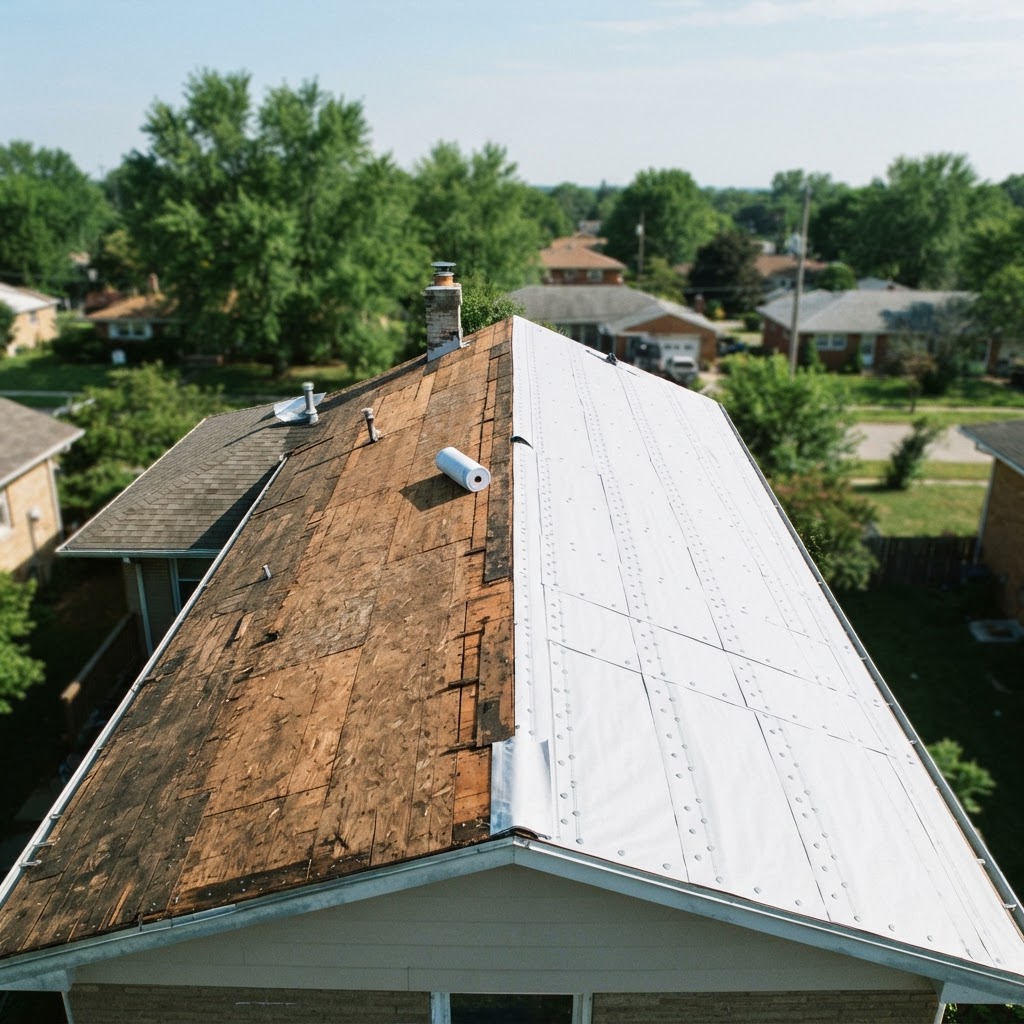
What Does Roof Underlayment Actually Do?
Every shingle roof is really a two-layer system. The shingles are the armor, designed to shed rain downhill and take the beating from the sun; the underlayment is the layer beneath, draped over the roof deck before shingles ever land. When wind lifts a shingle, when an ice dam pushes meltwater sideways, or when hail cracks a tab, underlayment is what stands between the weather and your drywall.
The International Residential Code requires at least one layer of underlayment beneath asphalt shingles, and most premium systems add self-adhering ice-and-water shield at the eaves, valleys, and penetrations where water attacks hardest. The field — everything else — is where the felt-versus-synthetic choice plays out. It is also the choice most homeowners never hear about, because it happens under the shingles where nobody looks.
How Does Synthetic Underlayment Differ From Asphalt Felt?
Asphalt felt has been the default since your grandfather’s roof. It comes in #15 and #30 weights — a reference to historical pounds per hundred square feet — and it works by saturating an organic or fiberglass mat with asphalt until it sheds water. It is cheap, proven, and code-accepted everywhere.
What Exactly Is #30 Felt?
#30 is the heavier of the two standard felts, roughly twice the thickness of #15, and it is what most quality roofers use on steep-slope asphalt jobs. It lays flatter and holds up better than #15 during installation, which is why we consider #15 essentially obsolete on full replacements. But even the best felt is still paper with a waterproof coating — one saturated or torn section and the deck underneath is exposed.
Put the two side by side and the gaps are hard to miss:
| Property | #15/#30 Asphalt Felt | Synthetic Underlayment |
|---|---|---|
| Tear strength | Tears readily at fasteners and wind edges | Woven polypropylene resists tearing under traffic |
| Coverage per roll | About 2 squares (#30), 4 (#15) | About 10 squares |
| Water holdout | Degrades when wet and re-dried repeatedly | Sheds water; very low absorption |
| UV exposure window | Cover the same day | Weeks to months, by printed spec |
| Surface for installers | Smooth and slippery when dusty or damp | Slip-resistant top face on quality lines |
| Lifespan match | Ages out before premium shingles do | Matches 20–30-year-plus systems |
Why Does Tear Strength Matter During Installation?
A roof under construction is a hostile place for a membrane. Workers in boots cross it dozens of times an hour, nail guns compress fasteners, a gust peels an unprotected edge, and a dropped bundle of shingles lands where it lands. Traditional felt tears at all four events, and a torn patch wrinkles, laps wrong, and can channel water straight to the deck.
Woven polypropylene changes the math. It holds mechanical fasteners with tight, cap-washed connections, resists the pull-through that rips felt, and stays flat under foot traffic instead of bunching. Crews also report the surface is more predictable to walk — quality synthetics carry a slip-resistant top face — which matters more than any brochure admits on a 10/12 pitch.
I have watched wind take a felt job apart in forty minutes flat. The same gust rolls off a woven synthetic like it is punching a mat — we stopped losing days to re-felting years ago.
— Production Foreman, Sam Construction Group USA
How Do Weight and Lay-Flat Handling Speed Up the Job?
The logistics are honestly underrated. A synthetic roll covers five times the roof per trip up the ladder, so crews spend less time hauling and more time laying; the membrane runs out flat and stays flat, with no sog-day ripples to bake into ridges. Wrinkled felt, by contrast, can telegraph lumps right through new architectural shingles and show up as waves on a sunny roofline.
Lay-flat also means lap integrity. Synthetic sheets lie down tight at overlaps, so the water path sheds cleanly course to course instead of bridging over puckered seams. On complex roofs full of valleys and dormers, that flatness is exactly where the assembly earns its water barrier rating. It is the difference between a barrier and a quilt.
From delivery to ridge, a well-run synthetic job follows the same sequence:
- Sweep and inspect the deck, replacing any compromised sheathing before it is buried.
- Roll out peel-and-stick ice-and-water shield at the eaves, valleys, and penetrations.
- Run the synthetic field from eave to ridge with the printed lap lines aligned.
- Fasten with cap nails on the printed pattern — no felt-style spot nailing.
- Cover within the printed UV window, or stage the next course and keep moving.
What Is the UV Exposure Advantage?
Asphalt felt degrades in sunlight. UV and heat cook the oils out of the coating, the paper dries, chalks, and weakens, and a deck left exposed for a week can need re-felting before shingles land. UV degradation is not cosmetic; it is a structural countdown, and it is why old-school crews planned felt-to-shingle work in same-day sprints.
Synthetic membranes are UV-stabilized by design, with exposure windows printed right on the wrapper — commonly 30, 90, or up to 180 days depending on grade. For homeowners, that resilience converts directly into schedule tolerance: a week of pop-up thunderstorms, a delayed inspection, or a delivery hiccup no longer costs a tear-out. Peel-and-stick self-adhering membranes extend the same philosophy at eaves and valleys, sealing around fasteners entirely where ice-and-water protection is required.
Is the Synthetic Upgrade Worth the Cost?
Run the amortization and the premium nearly disappears. On a typical Northern Virginia replacement in the $11,000-to-$17,000 range, stepping up from #30 felt to synthetic adds a few hundred dollars spread over 20 to 30 years of architectural shingle service. Meanwhile, major manufacturers increasingly tie enhanced coverage to complete assemblies — quality underlayment included — so the upgrade protects not just the deck but the manufacturer warranty behind the whole roof.
The honest counterpoint: felt is not a bad product. A #30 felt roof over a simple deck, installed by a careful crew and covered promptly, will serve a basic 3-tab roof fine for its 15-to-20-year life. Synthetic earns its keep on premium systems, complex roofs, long warranties, and any job where weather delays are likely.
When Is Felt Still the Right Choice?
Choose felt when the roof is a short-term hold, the budget is fixed to the dollar, or the system is a basic 3-tab replacement with no enhanced warranty ambitions. Everything else — architectural and luxury shingles, metal, slate, synthetics up top — deserves a water barrier that lasts as long as the roof does.
Before you approve the material, check the spec sheet for these five things:
- Tear and tensile strength ratings — woven, not fibrous
- A printed UV exposure window in days or months
- Slip-resistant surface treatment
- Fastener seal-through and cap compatibility
- An ICC-ES evaluation report or equivalent code listing
People obsess over shingle brochures and never ask what is under them. Ask. The underlayment is the difference between a leaking deck and a dry one when a shingle fails.
— Sam Construction Group USA, Fairfax roofing & restoration team
Synthetic Underlayment — Frequently Asked Questions
Is synthetic underlayment required by code?
No — code requires a water barrier under asphalt shingles, and both felt and synthetic qualify. Synthetic is a performance upgrade, not a legal requirement. Some manufacturer enhanced warranties, however, expect a listed underlayment as part of the roof system.
Can synthetic underlayment be left exposed all winter?
Only within its printed UV exposure window, which ranges from about one week to six months by grade. Beyond that window, even UV-stable material should be covered. If a project will stall, ask your contractor for the exact rating on the roll being installed.
Does ice-and-water shield replace underlayment?
No — peel-and-stick ice-and-water shield is a self-sealing membrane for eaves, valleys, and penetrations, and it works alongside the field underlayment, not instead of it. A full peel-and-stick deck wrap is possible on premium jobs. Most roofs combine both layers strategically.
Why did my last roofer use felt if synthetic is better?
Often it is simply habit or bid-shopping: felt keeps the sticker price down on a commodity quote. Some crews also stock it and know its timing quirks well. Neither reason makes felt the better material for a 20-to-30-year roof.
How much more does synthetic underlayment cost?
Expect roughly two percent more on a full replacement — a few hundred dollars on a typical Northern Virginia job. Against tear strength, UV tolerance, and warranty alignment, that is among the cheapest performance gains available in roofing.
Ready for a Roof Built From the Layers Down?
Shingles get the compliments; underlayment does the protecting. Sam Construction Group USA specs complete roofing systems — deck to ridge — for homeowners across the Northern Virginia and DMV area, and we put every material choice in writing.
☎ (571) 373-6388This article is general information for Northern Virginia property owners and is not a quote or a statement of any specific product’s terms. Costs, lifespans, and savings vary by home, climate, and product line — always confirm specifications for your own project. Free inspections: (571) 373-6388.